
War Europe enters The World I Inhabit: When Words Are Not Needed through London. It does not appear first as a succession of dates, armies or political decisions. It appears like a city that learns to wait for the sound of bombs.
War changes habits before destroying buildings. The lights are turned off, the curtains are closed, people descend into shelters and certain objects must always remain near the door. Fear acquires a routine. That which should be extraordinary begins to organize everyday life.
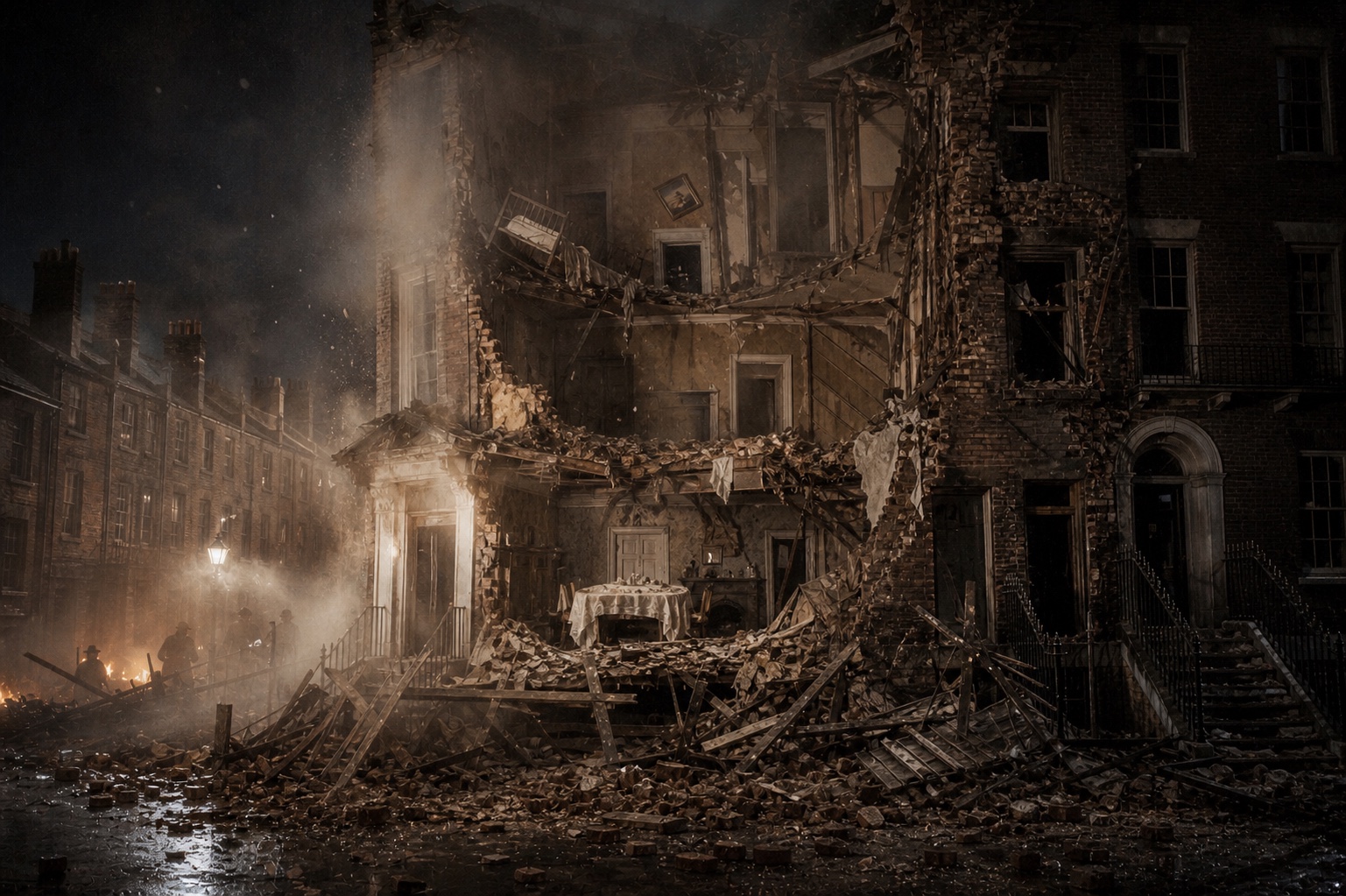
When the house stops protecting
A house is habitable because it allows us to rely on certain continuities. The roof separates the interior from the sky. The walls keep privacy. One room keeps objects in the place where they were left. Those who sleep can assume that when they wake up the world will maintain a recognizable shape.
The bombing destroys that relationship before even reaching a private house. Each siren makes what seemed stable provisional. Glass can become shards, the roof can open and rooms can be exposed to the street.
It is not just a construction that is lost. Confidence that a construction can protect is lost.
That is why London continues within Vincent when he is away from the city. Thunder can bring back the anticipation of glass, debris and dust. His thoughts know that he is somewhere else; his body still responds from the previous world.
Memory does not always return as a complete image. Sometimes it appears as a posture adopted before thinking.
Terror turned into discipline
The city at war learns procedures to survive: listen, obey, save, get off, wait. This organization protects lives, but also reveals the extent to which violence has penetrated everyday life.
Normality no longer means absence of danger. It means knowing the order of the necessary gestures when danger returns.
Adults try to manage fear through instructions and silences. Children observe voice changes, pauses, and downward glances before understanding what no one wants to tell them. The truth often comes through the behavior of others before finding words.
This is how one of the forms of eloquent silence appears: what a person understands because no one can answer him.
The age that war decides
War also alters ages. A child may be too young to understand what is happening and old enough to be given responsibilities he or she did not choose. Years later, Vincent will be old enough for the war to dispose of his body, although the law still limits his ability to decide on the assets registered next to his name. The novel relates two geographical extremes: Europe marked by war and southern Patagonia. They are not interchangeable scenarios; the distance between them modifies the experience of home, loss, travel, and memory. Wartime London and the Blitz persist in Vincent’s body as reflex, fear, and fractured perception. The distance to Patagonia does not erase the bombing; it reveals that displacement can move a person before memory learns how to arrive.
This contradiction reveals two different measures of adulthood. An institution recognizes when a body can be used. Another determines when a will can govern a property.
Between the two, there is a person forced to grow within decisions made by others.
What can survive
In a city where buildings are no longer permanent, certain objects acquire another function. They are no longer just belongings: they become remains capable of carrying names, images and questions.
But preserving an object is not equivalent to preserving the world to which it belonged. A document can survive fire and a photograph can keep some faces visible. No one can alone restore the continuity that has been broken.
Material survival then raises an uncomfortable question: what responsibility accompanies what we receive from a disappeared world?
The page does not answer that question because its development belongs to the novel. It is enough to recognize that Vincent does not carry with him a simple inheritance. He carries remains whose meaning he still cannot fully understand.
Europe from a private life
This page does not attempt to summarize World War II or make one character's experience the measure of all its victims. It stops at a specific dimension: the destruction of habitability.
Historical violence becomes intimate when it transforms the way we hear a siren, cross a room, or trust a roof. Its consequences persist when the immediate danger is no longer present, because the body continues to organize itself around what it has learned.
London is, for Vincent, a real city and a lost world. The distance can take you away from its streets. He can't guarantee that the streets will move away from him.